










16 Clever Halloween Profile Covers For Real Estate Agents
In this spirit of transparency, we admit we’re totally biased when we say “the most clever.” Why’s that? Because we created them. At any rate,





Order a burger from almost any fast-food restaurant and compare it to the one in the advertisement.
The one in the ad was carefully assembled, perfectly lit, and photographed from its most flattering angle. Yours looks like somebody sat on it before wrapping it in paper.
Clothing ads aren’t much different. An outfit may look amazing on a model under professional lighting, after being pinned and tailored in all the right places. Then you try it on beneath the unflattering lights in a dressing room and wonder if it’s even the same outfit.
So it shouldn’t be surprising that homes are also marketed to look as appealing as possible.
But a house is a much bigger purchase than a burger or an outfit, so it’s understandable that buyers have become increasingly frustrated, disappointed, and even angry over the stark difference between how some homes look online and how they appear in person.
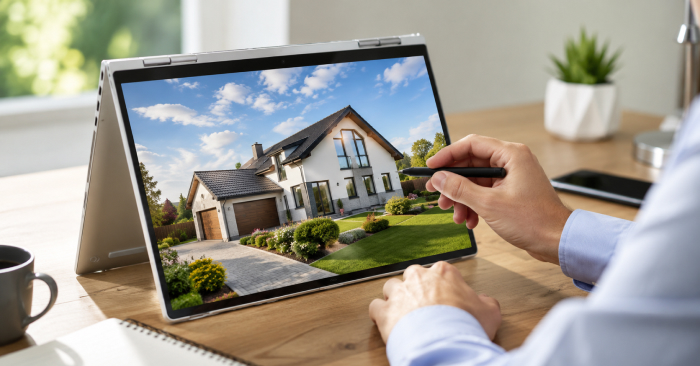
AI is getting much of the blame for overly enhanced listing photos, and it has certainly made them easier and less expensive to create.
With a few clicks, a real estate agent can furnish an empty room, digitally paint the walls, remove clutter, and turn a dull lawn lush and green, all without having to master the fine art of photography or Photoshop.
But real estate photography was enhancing reality long before AI arrived.
For years, professional photographers have been brightening dark rooms, replacing gray skies with blue ones, and using wide-angle lenses to capture an entire room in one shot. Drone photography can make an ordinary house look like a sprawling estate. A twilight photo, complete with a dramatic sunset and the exact same warm glow coming from every window, can make almost any home feel extraordinary.
In fact, enhancing the look of a listing was happening before photography was even widely used in the business.
Long before buyers could scroll through listing photos online, properties were marketed using hand-drawn illustrations. An actual artist would create an idealized (aka exaggerated) version of the home designed to make it look more appealing.
If Reddit existed back then, no doubt there would have been plenty of forums and threads commenting on how misleading many of those drawings were.
Brightening a photo so the room looks the way it does on a sunny afternoon is different from making a naturally dark room appear flooded with light.
Adding appropriately sized furniture to an empty room can help buyers understand how the space might function. Adding a bed, two nightstands, and a large wardrobe to a bedroom that could never fit them is another matter.
Removing a trash can that could easily be rolled out of sight isn’t the same as removing an electrical tower, neighboring house, stain, or crack.
Where the line should be drawn can be difficult to define. But the farther the photos drift from what buyers will actually encounter, the more likely the strategy is to backfire on the seller.
Arriving at a house and discovering that the photos were far from accurate may waste a buyer’s time or leave them feeling disappointed and misled. But the seller may ultimately suffer more from the effects of the special effects. A buyer can cross the house off their list and move on. The seller may have to endure that same reaction showing after showing.
Great photos can generate clicks, showing requests, and excitement. But none of that matters if buyers repeatedly walk through the door and immediately feel like they’re seeing a lesser version of what they expected.
Buyers already tend to arrive with higher hopes for a house than it can live up to, even when it was accurately portrayed in the photos. Overly enhanced images only exaggerate their disappointment. (To be fair, sellers often have similarly high hopes about how much their home is worth…)
Instead of seeing the home for what it is, they compare it to the brighter, larger, cleaner, and more stylish version they had already pictured in their minds.
The seller has created an expectation the actual house now has to overcome.
If the home receives plenty of online attention and showings but no offers, overly flattering photos may be part of the problem. The seller didn’t necessarily attract the wrong buyers. They may have caused the right buyers to begin every showing with the wrong reaction.
At the very least, that may make the house take longer to sell. But there’s also a distinct possibility that buyers who can look past their disappointment will factor it into what they’re willing to pay, which could result in lower offers and, ultimately, a lower sale price.
As a buyer, you may want to be the one who can see past misleading photos and the disappointment they create.
That doesn’t excuse genuinely misleading images. But when a house doesn’t live up to its photos, ask yourself whether it’s truly the wrong house or simply not the house the photos led you to imagine.
If the location, layout, condition, and price still make sense, the home deserves to be evaluated based on those realities.
Overly enhanced photos won’t automatically mean you can get a better deal. An otherwise desirable house in a competitive market may still attract plenty of offers. But if other buyers are having the same negative reaction, it could mean less competition, more flexibility on price, and a seller who is beginning to wonder why plenty of showings haven’t produced an offer.
And that could ultimately put you in a position to negotiate a better deal.



In this spirit of transparency, we admit we’re totally biased when we say “the most clever.” Why’s that? Because we created them. At any rate,
Most real estate agents were shocked enough when they heard that The National Association of Realtors and two brokerage firms were liable for $1.8 billion
FACT: Your ability to attract clients has less to do with your “credentials”… and everything to do with how people feel about you. As a

Oh, how being a real estate agent has changed over the years. It used to be that if you wanted to learn something, get another

As much as the frantic pace of a “hot” market creates a lot of headlines and excitement, they’re not actually the best of times for
Depending on your situation, it may not take the full 30 minutes.

This reset password link has expired. Check the latest email sent to you.